One sees little reference to evil in Confucian writings. Of course, the word "evil" has over-tones in a Christian society. One dictionary definition, e.g., calls it "a cosmic evil force." In Confucianism,
another definition is better: "something that brings sorrow, distress, or calamity."
Here is what I have found in "Learning to Be a Sage, Conversations of Master Chu" translated by Daniel Gardner (isbn 0-520-06525-5):
p. 165, #6.15
"...concentrate your mental energy, and whatever is obscure to you and whatever evil thoughts you might have will disappear...."
p.165 & 166, #6.18
"...Man's nature is in all instances good; it's simply because man has let go of his mind that he falls into evil."
And also this:
"Never can what has been allotted to man by the yin and yang psychophysical stuff [chi] and the five agents contain evil. It's simply because man himself does not move toward the good that he becomes evil."
And also this:
"...it's important that in those places where good and evil have become mixed students disentangle them; they mustn't let the shoots of goodness that grow in even the smallest patch of evil be cut down."
Notice how main stream Confucianism holds to belief in the innate goodness of humanity.
One rarely sees evil mentioned in Confucian writings. I did a google search on "good + evil + Confucianism" and found this web page:
http://www.onelittleangel.com/wisdom/quotes/religion_net.asp?mc=16
You will have to use the "find in this page" tool of your web browser to find the occurrences of "evil" on the page. There are more than one.
That web page has this quote from Wang Yangming:
"In the original substance of the mind there is no distinction of good and evil. When the will becomes active, however, such distinction exists. The faculty of innate knowledge is to know good and evil. The investigation of things is to do good and to remove evil."
"The investigation of things" is a major topic in itself, but is too much to add to this article.
Finally, I'll mention the best book I've seen on the topic of evil: "People of the Lie, the Hope for Healing Human Evil" by M. Scott Peck. There are a number of books on the topic of evil referenced by Peck. I will warn you that Peck's book crumbles into confused mysticism at the end. It's a good book with no suggestions for a solution.
Scott Peck once tried to do an exorcism. Yes, he tried to drive out demons. No, he is not Catholic. The problem of evil seemed to drive him "around the bend."
Confucianism is rational and balanced. Confucianism is thoughtful, deep, and considers many topics also of interest to Christians.
Saturday, October 28, 2017

Confucius on the Sage
Have you wondered what Confucious said about the sage? I have assembled the quotes for you. All references to “sage” (in bold font) from The Analects of Confucius, translation by James Legge. This version is available for free download from Project Gutenberg.
BOOK III
CHAP. XXIV.
The border warden at Yi requested to be introduced to the
Master, saying, 'When men of superior virtue have come to this, I have never
been denied the privilege of seeing them.' The followers of the sage introduced him, and when he came
out from the interview, he said, 'My friends, why are you distressed by your
master's loss of office? The kingdom has long been without the principles of
truth and right; Heaven is going to use your master as a bell with its wooden
tongue.'
BOOK VI
CHAP. XXVIII.
1.
Tsze-kung said, 'Suppose the case of a man extensively conferring benefits on
the people, and able to assist all, what would you say of him? Might he be
called perfectly virtuous?' The Master said, 'Why speak only of virtue in
connection with him? Must he not have the qualities of a sage? Even Yao and Shun were still solicitous about this.
2. 'Now the
man of perfect virtue, wishing to be established himself, seeks also to
establish others; wishing to be enlarged himself, he seeks also to enlarge
others.
3. 'To be able to judge of others by what is
nigh in ourselves — this may be called the art of virtue.'
BOOK VII
CHAP. XXV.
1. The
Master said, 'A sage it is not mine
to see; could I see a man of real talent and virtue, that would satisfy me.'
2. The Master said, 'A good man it is not
mine to see; could I see a man possessed of constancy, that would satisfy me.
3. 'Having
not and yet affecting to have, empty and yet affecting to be full, straitened
and yet affecting to be at ease — it is difficult with such characteristics to
have constancy.'
BOOK VII
CHAP. XXXIII.
The Master said, 'The sage and the man of perfect virtue — how dare I rank myself with
them? It may simply be said of me, that I strive to become such without
satiety, and teach others without weariness.' Kung-hsi Hwa said, 'This is just
what we, the disciples, cannot imitate you in.'
BOOK IX
CHAP. VI.
1. A high
officer asked Tsze-kung, saying, 'May we not say that your Master is a sage? How various is his ability!'
2.
Tsze-kung said, 'Certainly Heaven has endowed him unlimitedly. He is about a sage. And, moreover, his ability is
various.'
3. The
Master heard of the conversation and said, 'Does the high officer know me? When
I was young, my condition was low, and therefore I acquired my ability in many
things, but they were mean matters. Must the superior man have such variety of
ability? He does not need variety of ability.'
4. Lao
said, 'The Master said, "Having no official employment, I acquired many
arts."'
BOOK XI
CHAP. XIX.
Tsze-chang asked what were the characteristics of the
GOOD man. The Master said, 'He does not tread in the footsteps of others, but
moreover, he does not enter the chamber of the sage.'
BOOK XVI
CHAP. VIII.
1. Confucius said, 'There are three things
of which the superior man stands in awe. He stands in awe of the ordinances of
Heaven. He stands in awe of great men. He stands in awe of the words of sages.
2. 'The
mean man does not know the ordinances of Heaven, and consequently does not
stand in awe of them. He is disrespectful to great men. He makes sport of the
words of sages.'
BOOK XIX
CHAP. XII.
1. Tsze-yu
said, 'The disciples and followers of Tsze-hsia, in sprinkling and sweeping the
ground, in answering and replying, in advancing and receding, are sufficiently
accomplished.
But these are only the branches of learning, and they are
left ignorant of what is essential.-- How can they be acknowledged as
sufficiently taught?'
2. Tsze-hsia
heard of the remark and said, 'Alas! Yen Yu is wrong. According to the way of
the superior man in teaching, what departments are there which he considers of
prime importance, and delivers? what are there which he considers of secondary
importance, and allows himself to be idle about? But as in the case of plants,
which are assorted according to their classes, so he deals with his disciples.
How can the way of a superior man be such as to
make fools of any of them? Is it not the sage alone, who can unite in one the
beginning and the consummation of learning?'
BOOK XIX
CHAP. XXIV.
Shu-sun Wu-shu having spoken revilingly of Chung-ni,
Tsze-kung said, 'It is of no use doing so. Chung-ni cannot be reviled. The
talents and virtue of other men are hillocks and mounds which may be stepped
over. Chung-ni is the sun or moon, which it is not possible to step over.
Although a man may wish to cut himself off from the sage, what harm can he do to the sun or
moon? He only shows that he does not know his own capacity.
BOOK XIX
CHAP. XXV.
1. Ch'an
Tsze-ch'in, addressing Tsze-kung, said, 'You are too modest. How can Chung-ni
be said to be superior to you?'
2.
Tsze-kung said to him, 'For one word a man is often deemed to be wise, and for
one word he is often deemed to be foolish. We ought to be careful indeed in
what we say.
3. 'Our
Master cannot be attained to, just in the same way as the heavens cannot be
gone up to by the steps of a stair.
4. 'Were
our Master in the position of the ruler of a State or the chief of a Family, we
should find verified the description which has been given of a sage's rule — he would plant the
people, and forthwith they would be established; he would lead them on, and
forthwith they would follow him; he would make them happy, and forthwith
multitudes would resort to his dominions; he would stimulate them, and
forthwith they would be harmonious. While he lived, he would be glorious. When
he died, he would be bitterly lamented. How is it possible for him to be
attained to?'
Confucious on Wisdom
Have you wondered what Confucious said about wisdom?
I have assembled the quotes for you.
All references to "wisdom"
(in bold font) are from The Analects of Confucius, translation by James
Legge. This version is available for
free download from Project Gutenberg. I
downloaded this version as a text file and did a text search on the word "wisdom."
BOOK V
CHAP. XVII.
The Master said, 'Tsang Wan kept a large tortoise in a house, on the capitals
of the pillars of which he had hills made, and with representations of duckweed
on the small pillars above the beams supporting the rafters.-- Of what sort was
his wisdom?'
BOOK V
CHAP. XX. The
Master said, 'When good order prevailed in his country, Ning Wu acted the part
of a wise man. When his country was in disorder, he acted the part of a stupid
man. Others may equal his wisdom,
but they cannot equal his stupidity.'
BOOK VI
CHAP. XX. Fan
Ch'ih asked what constituted wisdom.
The Master said, 'To give one's self earnestly to the duties due to men, and,
while respecting spiritual beings, to keep aloof from them, may be called wisdom.' He asked about perfect virtue.
The Master said, 'The man of virtue makes the difficulty to be overcome his
first business, and success only a subsequent consideration; -- this may be
called perfect virtue.'
BOOK XVII
CHAP.
XXIV
1.
Tsze-kung said, 'Has the superior man his hatreds also?' The Master said, 'He
has his hatreds. He hates those who proclaim the evil of others. He hates the
man who, being in a low station, slanders his superiors. He hates those who have
valour merely, and are unobservant of propriety. He hates those who are forward
and determined, and, at the same time, of contracted understanding.'
2. The Master
then inquired, 'Ts'ze, have you also your hatreds?' Tsze-kung replied, 'I hate
those who pry out matters, and ascribe the knowledge to their wisdom. I hate those who are only not
modest, and think that they are valorous. I hate those who make known secrets,
and think that they are straightforward.'
Confucius on Evil
Have you wondered what Confucious said about evil? I have assembled the quotes for you. All references to “evil”
(in bold font) are from The
Analects of Confucius, translation by James Legge. This version is available for free download
from Project Gutenberg. I downloaded this version as a text file and did a text search on the word "evil."
BOOK XII
CHAP. XXI.
1. Fan Ch'ih
rambling with the Master under the trees about the rain altars, said, 'I
venture to ask how to exalt virtue, to correct cherished evil, and to discover delusions.'
2. The
Master said, 'Truly a good question!
3. 'If
doing what is to be done be made the first business, and success a secondary
consideration;-- is not this the way to exalt virtue? To
assail one's own wickedness and not assail
that of others;-- is not this the way to correct
cherished evil? For a morning's
anger to disregard
one's own life, and involve that of his parents;-- is not
this a case of delusion?'
BOOK XV
CHAP. XXIV.
1. The
Master said, 'In my dealings with men, whose evil do I blame, whose goodness do I
praise, beyond what is proper? If I do sometimes exceed
in praise, there must be ground
for it in my examination of the individual.
2. 'This
people supplied the ground why the three dynasties pursued the path of
straightforwardness.'
BOOK XVI
CHAP. XI.
1.
Confucius said, 'Contemplating good, and pursuing it, as if they could not
reach it;
contemplating evil,
and shrinking from it, as they would from thrusting the hand into boiling
water:-- I have seen such men, as I have heard such
words.
2. 'Living
in retirement to study their aims, and practicing righteousness to carry out
their principles:-- I have heard these words, but I have
not seen such men.'
BOOK XVII
CHAP. VII.
1. Pi Hsi
inviting him to visit him, the Master was inclined to go.
2. Tsze-lu
said, 'Master, formerly I have heard you say, "When a man in his own
person is
guilty of doing
evil, a superior man will not associate with him." Pi Hsi is in
rebellion, holding
possession of Chung-mau; if you go to him, what shall be
said?'
3. The
Master said, 'Yes, I did use these words. But is it not said, that, if a thing
be
really hard, it may be ground without being made thin? Is
it not said, that, if a thing be really
white, it may be steeped in a dark fluid without being
made black?
4. 'Am I a
bitter gourd! How can I be hung up out of the way of being eaten?'
BOOK XVII
CHAP. XXIV.
1.
Tsze-kung said, 'Has the superior man his hatreds also?' The Master said, 'He
has his
hatreds. He hates those who proclaim the evil of others. He hates the man who, being
in a low
station, slanders his superiors. He hates those who have valor
merely, and are unobservant of
propriety. He hates those who are forward and determined,
and, at the same time, of contracted
understanding.'
2. The
Master then inquired, 'Ts'ze, have you also your hatreds?' Tsze-kung replied,
'I hate
those who pry out matters, and ascribe the knowledge to
their wisdom. I hate those who are only
not modest, and think that they are valorous. I hate
those who make known secrets, and think that they are straightforward.'
BOOK XIX
CHAP. XX.
Tsze-kung said, 'Chau's wickedness was not so great as
that name implies. Therefore, the superior man hates to dwell in a low-lying
situation, where all the evil of the
world will flow in upon him.'
Sunday, October 22, 2017
About The Great Learning
Said to have been written by Confucius, The Great Learning is one of the cannonical Confucian works.
The Confucian scholar Chu Hsi (Zhu Xi) promoted The Four Books for the essential study of Confucianism: The Analects, The Mencius, The Great Learning, and The Doctrine of the Mean.
Below is a copy of The Great Learning, translated by James Legge. A printable copy is available at this link. Also, Daniel Gardner has a fine translation of The Great Learning in his work, The Four Books: The Basic Teachings of the Later Confucian Tradition.
The Great Learning by Confucius
Translated by James Legge
[Section 1]
What the Great Learning teaches, is to illustrate illustrious virtue; to renovate the people; and to rest in the highest excellence. The point where to rest being known, the object of pursuit is then determined; and, that being determined, a calm unperturbedness may be attained to. To that calmness there will succeed a tranquil repose. In that repose there may be careful deliberation, and that deliberation will be followed by the attainment of the desired end.
Things have their root and their branches. Affairs have their end and their beginning. To know what is first and what is last will lead near to what is taught in the Great Learning.
[Section 2]
The ancients who wished to illustrate illustrious virtue throughout the kingdom, first ordered well their own states. Wishing to order well their states, they first regulated their families. Wishing to regulate their families, they first cultivated their persons. Wishing to cultivate
their persons, they first rectified their hearts. Wishing to rectify their hearts, they first sought to be sincere in their thoughts. Wishing to be sincere in their thoughts, they first extended to the utmost their knowledge. Such extension of knowledge lay in the investigation of things.
Things being investigated, knowledge became complete. Their knowledge being complete, their thoughts were sincere. Their thoughts being sincere, their hearts were then rectified. Their hearts being rectified, their persons were cultivated. Their persons being cultivated,
their families were regulated. Their families being regulated, their states were rightly governed. Their states being rightly governed, the whole kingdom was made tranquil and happy.
[Section 3]
From the Son of Heaven down to the mass of the people, all must consider the cultivation of the person the root of everything besides. It cannot be, when the root is neglected, that what should spring from it will be well ordered. It never has been the case that what was of great importance has been slightly cared for, and, at the same time, that what was of slight importance has been greatly cared for.
(From “Confucian Analects, The Great Learning, & The Doctrine of the Mean,” Dover Publications, ISBN 0-486-22746-4)
The Confucian scholar Chu Hsi (Zhu Xi) promoted The Four Books for the essential study of Confucianism: The Analects, The Mencius, The Great Learning, and The Doctrine of the Mean.
Below is a copy of The Great Learning, translated by James Legge. A printable copy is available at this link. Also, Daniel Gardner has a fine translation of The Great Learning in his work, The Four Books: The Basic Teachings of the Later Confucian Tradition.
The Great Learning by Confucius
Translated by James Legge
[Section 1]
What the Great Learning teaches, is to illustrate illustrious virtue; to renovate the people; and to rest in the highest excellence. The point where to rest being known, the object of pursuit is then determined; and, that being determined, a calm unperturbedness may be attained to. To that calmness there will succeed a tranquil repose. In that repose there may be careful deliberation, and that deliberation will be followed by the attainment of the desired end.
Things have their root and their branches. Affairs have their end and their beginning. To know what is first and what is last will lead near to what is taught in the Great Learning.
[Section 2]
The ancients who wished to illustrate illustrious virtue throughout the kingdom, first ordered well their own states. Wishing to order well their states, they first regulated their families. Wishing to regulate their families, they first cultivated their persons. Wishing to cultivate
their persons, they first rectified their hearts. Wishing to rectify their hearts, they first sought to be sincere in their thoughts. Wishing to be sincere in their thoughts, they first extended to the utmost their knowledge. Such extension of knowledge lay in the investigation of things.
Things being investigated, knowledge became complete. Their knowledge being complete, their thoughts were sincere. Their thoughts being sincere, their hearts were then rectified. Their hearts being rectified, their persons were cultivated. Their persons being cultivated,
their families were regulated. Their families being regulated, their states were rightly governed. Their states being rightly governed, the whole kingdom was made tranquil and happy.
[Section 3]
From the Son of Heaven down to the mass of the people, all must consider the cultivation of the person the root of everything besides. It cannot be, when the root is neglected, that what should spring from it will be well ordered. It never has been the case that what was of great importance has been slightly cared for, and, at the same time, that what was of slight importance has been greatly cared for.
(From “Confucian Analects, The Great Learning, & The Doctrine of the Mean,” Dover Publications, ISBN 0-486-22746-4)
The Five Virtues
When you study Confucianism you will eventually run across references to the Five Virtues which are mentioned in Book XVII, Chapter VI, of the Analects of Confucius. Here is that selection from the translation by James Legge, which is in the public domain.
Tsze-chang asked Confucius about perfect virtue.
Confucius said, 'To be able to practice five things everywhere under heaven
constitutes perfect virtue.'
He begged to ask what they were, and was told, 'Gravity, generosity of
soul, sincerity, earnestness, and kindness. If you are grave, you will not
be treated with disrespect. If you are generous, you will win all. If you
are sincere, people will repose trust in you. If you are earnest, you will
accomplish much. If you are kind, this will enable you to employ
the services of others.
So if you were to simply list the Five Virtues, you will see after some study that they vary by translator. Here are the Five Virtues from four translators.
From James Legge
From Xinzhong Yao
From Wm. Theodore de Bary
From Tu Wei-Ming
Tsze-chang asked Confucius about perfect virtue.
Confucius said, 'To be able to practice five things everywhere under heaven
constitutes perfect virtue.'
He begged to ask what they were, and was told, 'Gravity, generosity of
soul, sincerity, earnestness, and kindness. If you are grave, you will not
be treated with disrespect. If you are generous, you will win all. If you
are sincere, people will repose trust in you. If you are earnest, you will
accomplish much. If you are kind, this will enable you to employ
the services of others.
So if you were to simply list the Five Virtues, you will see after some study that they vary by translator. Here are the Five Virtues from four translators.
From James Legge
- Gravity
- Generosity
- Sincerity
- Earnestness
- Kindness
From Xinzhong Yao
- Respectfulness
- Generosity
- Faithfulness
- Diligence
- Liberality
From Wm. Theodore de Bary
- Courtesy
- Magnanimity
- Trustworthiness
- Diligence
- Kindness
From Tu Wei-Ming
- Propriety
- Wisdom
- Faithfulness
- Righteousness
- Humanity
Sunday, May 10, 2015
To Advance, Help Others to Advance
This is a Confucian principle I put into practice: To advance, help others to advance. But I also practice a variant of this principle: To advance your child, help other children to advance. Strong communities make strong families and strong children. This is why I have created blogs to advance our children and our communities. Two blogs to advance our children are Plano Parents and Canright on Software and Programming. One blog to advance our communities is Texas Ascendant.
I discuss this Confucian principle on page 108 of my book, Achieve Lasting Happiness, a book that makes Confucianism accessible.
From an older rendition of the Confucian sayings (Analects), the quote goes like this: "Now the man of perfect virtue, wishing to be established himself, seeks also to establish others; wishing to be enlarged himself, he seeks also to enlarge others."
Ancient Confucian teachings have many practical applications in contemporary American life. My book puts the Analects into contemporary language to make these sayings accessible.
Robert
The quote I used is from Book VI, CHAP. XXVIII (this is the traditional numbering scheme). The complete section reads as follows:
1. Tsze-kung said, 'Suppose the case of a man extensively conferring benefits on the people, and able to assist all, what would you say of him? Might he be called perfectly virtuous?'
The Master said, 'Why speak only of virtue in connexion with him? Must he not have the qualities of a sage? Even Yao and Shun were still solicitous about this.
2. 'Now the man of perfect virtue, wishing to be established himself, seeks also to establish others; wishing to be enlarged himself, he seeks also to enlarge others.
3. 'To be able to judge of others by what is nigh in ourselves;-- this may be called the art of virtue.'
I discuss this Confucian principle on page 108 of my book, Achieve Lasting Happiness, a book that makes Confucianism accessible.
From an older rendition of the Confucian sayings (Analects), the quote goes like this: "Now the man of perfect virtue, wishing to be established himself, seeks also to establish others; wishing to be enlarged himself, he seeks also to enlarge others."
Ancient Confucian teachings have many practical applications in contemporary American life. My book puts the Analects into contemporary language to make these sayings accessible.
Robert
The quote I used is from Book VI, CHAP. XXVIII (this is the traditional numbering scheme). The complete section reads as follows:
1. Tsze-kung said, 'Suppose the case of a man extensively conferring benefits on the people, and able to assist all, what would you say of him? Might he be called perfectly virtuous?'
The Master said, 'Why speak only of virtue in connexion with him? Must he not have the qualities of a sage? Even Yao and Shun were still solicitous about this.
2. 'Now the man of perfect virtue, wishing to be established himself, seeks also to establish others; wishing to be enlarged himself, he seeks also to enlarge others.
3. 'To be able to judge of others by what is nigh in ourselves;-- this may be called the art of virtue.'
Tuesday, March 05, 2013
The Six Maxims of Ming Taizu
The Six Maxims of Ming Taizu is a simple list of rules to live by. The list is attributed to Ming Taizu, also known as Zhu Yuanzhang, the Hongwu Emperor, the founder and first emperor of China's Ming dynasty. This list also appeared earlier in Zhu Xi’s exhortation to villagers on how to manage their lives, as mentioned here. The Six Maxims are mentioned in Asian Values and Human Rights: A Confucian Communitarian Perspective by William T. De Bary and Sources of Chinese Tradition, Volume 2, by William Theodore De Bary.
Here is the list:
1. Be dutiful to your parents.
2. Be respectful to your elders.
3. Live in harmony with your neighbors.
4. Instruct your children and grandchildren.
5. Be content with your calling.
6. Do no evil.
They are as pertinent today as they were then.
Robert
Here is the list:
1. Be dutiful to your parents.
2. Be respectful to your elders.
3. Live in harmony with your neighbors.
4. Instruct your children and grandchildren.
5. Be content with your calling.
6. Do no evil.
They are as pertinent today as they were then.
Robert
Sunday, March 01, 2009
Getting Out of the Rabbit Hole and Getting Engaged, Analect 18.6
Besides being a Confucian, I am also a Christian. One of our preachers, Dave Stevens, recently quoted Jon Johnson who said, "Many believers are 'rabbit hole' Christians. In the morning they pop out of their safe Christian homes, hold their breath at work, and scurry home to their families and then off to their Bible studies, and finally end the day praying for the unbelievers they safely avoided all day."
Dave commented on this, saying,
"Don't be fooled; it takes courage to shine like lights in a dark world."
Later Dave said,
"I believe that we should be in the world but not of the world. However, for whatever reason, many are not even in the world while they try to not be of the world."
Dave raised an excellent point that applies to all people who believe in the life of virtue and service. I mentioned in an earlier post that Confucians are engaged. Confucians and Christians alike share the need to be engaged in helping humanity and promoting the virtuous life, and we share the reluctance to become personally engaged.
The Great Learning opens this way, after Gardner,
"The Way of Great Learning lies in letting one’s inborn luminous virtue shine forth, in renewing the people, and in coming to rest in perfect goodness."
Yes, Confucians too are supposed to shine like lights in a dark world.
Some Christians have turned their back on humanity and withdrawn into monastic orders, and some Chinese suggested to Confucius that he withdraw from the troubled world. Here is the account of that meeting and Confucius' reply: that he needed to associate with people instead of birds and beasts because the Chinese state needed to change:
Analect 18.6, also known as
BOOK XVIII. WEI TSZE
CHAP. VI. (Legge's translation)
1. Ch'ang-tsu and Chieh-ni were at work in the field together, when Confucius passed by them, and sent Tsze-lu to inquire for the ford.
2. Ch'ang-tsu said, 'Who is he that holds the reins in the carriage there?' Tsze-lu told him, 'It is K'ung Ch'iu.' 'Is it not K'ung Ch'iu of Lu?' asked he. 'Yes,' was the reply, to which the other rejoined, 'He knows the ford.'
3. Tsze-lu then inquired of Chieh-ni, who said to him, 'Who are you, sir?' He answered, 'I am Chung Yu.' 'Are you not the disciple of K'ung Ch'iu of Lu?' asked the other. 'I am,' replied he, and then Chieh-ni said to him, 'Disorder, like a swelling flood,spreads over the whole empire, and who is he that will change its state for you? Than follow one who merely withdraws from this one and that one, had you not better follow those who have withdrawn from the world altogether?' With this he fell to covering up the seed, and proceeded with his work, without stopping.
4. Tsze-lu went and reported their remarks, when the Master observed with a sigh, 'It is impossible to associate with birds and beasts, as if they were the same with us. If I associate not with these people,-- with mankind,-- with whom shall I associate? If right principles prevailed through the empire, there would be no use for me to change its state.'
Virtuous people need to be engaged in helping humanity.
Robert Canright
Dave commented on this, saying,
"Don't be fooled; it takes courage to shine like lights in a dark world."
Later Dave said,
"I believe that we should be in the world but not of the world. However, for whatever reason, many are not even in the world while they try to not be of the world."
Dave raised an excellent point that applies to all people who believe in the life of virtue and service. I mentioned in an earlier post that Confucians are engaged. Confucians and Christians alike share the need to be engaged in helping humanity and promoting the virtuous life, and we share the reluctance to become personally engaged.
The Great Learning opens this way, after Gardner,
"The Way of Great Learning lies in letting one’s inborn luminous virtue shine forth, in renewing the people, and in coming to rest in perfect goodness."
Yes, Confucians too are supposed to shine like lights in a dark world.
Some Christians have turned their back on humanity and withdrawn into monastic orders, and some Chinese suggested to Confucius that he withdraw from the troubled world. Here is the account of that meeting and Confucius' reply: that he needed to associate with people instead of birds and beasts because the Chinese state needed to change:
Analect 18.6, also known as
BOOK XVIII. WEI TSZE
CHAP. VI. (Legge's translation)
1. Ch'ang-tsu and Chieh-ni were at work in the field together, when Confucius passed by them, and sent Tsze-lu to inquire for the ford.
2. Ch'ang-tsu said, 'Who is he that holds the reins in the carriage there?' Tsze-lu told him, 'It is K'ung Ch'iu.' 'Is it not K'ung Ch'iu of Lu?' asked he. 'Yes,' was the reply, to which the other rejoined, 'He knows the ford.'
3. Tsze-lu then inquired of Chieh-ni, who said to him, 'Who are you, sir?' He answered, 'I am Chung Yu.' 'Are you not the disciple of K'ung Ch'iu of Lu?' asked the other. 'I am,' replied he, and then Chieh-ni said to him, 'Disorder, like a swelling flood,spreads over the whole empire, and who is he that will change its state for you? Than follow one who merely withdraws from this one and that one, had you not better follow those who have withdrawn from the world altogether?' With this he fell to covering up the seed, and proceeded with his work, without stopping.
4. Tsze-lu went and reported their remarks, when the Master observed with a sigh, 'It is impossible to associate with birds and beasts, as if they were the same with us. If I associate not with these people,-- with mankind,-- with whom shall I associate? If right principles prevailed through the empire, there would be no use for me to change its state.'
Virtuous people need to be engaged in helping humanity.
Robert Canright
Wednesday, January 28, 2009
The Five Loves and Commitments of Confucianism
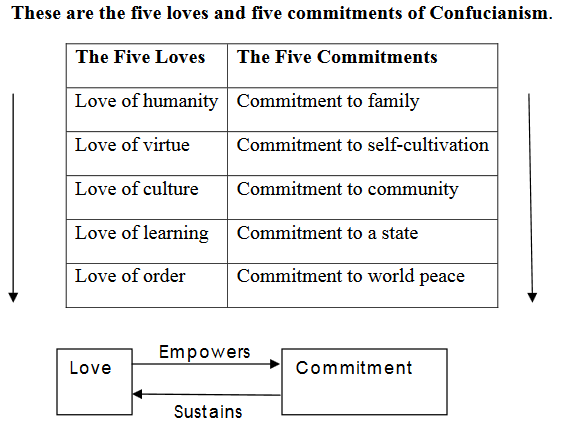
“Know thyself,” said the temple at Delphi. Only you can peer into your heart and know what you truly love, but others can see your actions and see your commitments. These are related. Love empowers commitment; commitment sustains love.
What are the loves and commitments of Confucianism, the Ru Jia? To become a noble person I believe one starts by loving humanity. The love of humanity leads to a love of virtue. The love of virtue leads to a love of culture. The love of culture leads to a love of learning. And the love of learning leads to a love of order.
I believe the first commitment of a noble person is to family. The commitment to family enables a commitment to self-cultivation. The commitment to self-cultivation enables a commitment to community. A commitment to community enables commitment to a state. And a true commitment to a state should enable commitment to world peace, because no state is truly secure unless all states live in harmony.
A love for humanity empowers a family. A love of virtue empowers self-cultivation. A love of culture empowers community. A love of learning empowers a state. And a love of order empowers world peace.
World peace sustains order. A successful state sustains learning. Successful communities sustain culture. Successful self-cultivation sustains virtue. And successful families sustain humanity.
I have diagrammed these relationships. Click on the image to enlarge it.

This is my contribution to modern Confucianism.
Robert
What are the loves and commitments of Confucianism, the Ru Jia? To become a noble person I believe one starts by loving humanity. The love of humanity leads to a love of virtue. The love of virtue leads to a love of culture. The love of culture leads to a love of learning. And the love of learning leads to a love of order.
I believe the first commitment of a noble person is to family. The commitment to family enables a commitment to self-cultivation. The commitment to self-cultivation enables a commitment to community. A commitment to community enables commitment to a state. And a true commitment to a state should enable commitment to world peace, because no state is truly secure unless all states live in harmony.
A love for humanity empowers a family. A love of virtue empowers self-cultivation. A love of culture empowers community. A love of learning empowers a state. And a love of order empowers world peace.
World peace sustains order. A successful state sustains learning. Successful communities sustain culture. Successful self-cultivation sustains virtue. And successful families sustain humanity.
I have diagrammed these relationships. Click on the image to enlarge it.
This is my contribution to modern Confucianism.
Robert
Friday, January 02, 2009
Canonical Books and America's Future
A canon is an accepted body of related works. Mortimer Adler, the University of Chicago, and the Encyclopedia Britannica assembled and published 60 volumes of works called Great Books of the Western World. Adler studied at Columbia University where John Erskine developed classes based on Masterworks of Western Literature. Great Books courses have been very influential. The famous philosopher Richard Rorty studied the Great Books at the University of Chicago. Thirty years after graduating from Columbia University, the writer David Denby re-enrolled in the Great Books courses at Columbia and wrote "Great Books" about the experience. More recently Alex Beam has written, "A Great Idea at the Time: The Rise, Fall, and Curious Afterlife of the Great Books." As the quality of American education has declined, so has the study of the Great Books.
For a household or for an individual, the main problem with the Great Books is their quantity. Any list you find will have 100 or more works. Who can trully absorb that much? Who can absorb Plato's Republic in one reading?
The Confucian tradition, the Ru Jia, has a much shorter list. Even though Confucian scholars have been writing for thousands of years and many brilliant works have been produced, the Confucians have as their canon The Four Books and the Five Classics.
The Four Books are The Analects, The Mencius, The Great Learning, and The Doctrine of the Mean.
The Five Classics are The Book of Poetry (also called The Book of Songs or The Odes), The Book of Rites (also called The Liki), The Spring and Autumn Annuals (a history of the state of Lu), The Book of History (ancient Chinese history), and The Book of Changes (also called The I Ching).
The Four Books are the Core Curriculum of the Confucian tradition and they are remarkably compact. The Analects and the Mencius are books, but the Great Learning and the Doctrine of the Mean are essays.
The Four Books are brilliant works. You can read them all in a month or two, but spend years studying the width and breadth of their wisdom.
The Confucian tradition is a sub-set of Chinese culture as Stoicism is a sub-set of Western philosophy, so it makes sense that the classical Confucian tradition can be represented by four books while it takes over 100 books to represent Western civilization.
The Christian tradition is represented by one canonical book, the Bible. Some Christians might have a second book like The Institutes of the Christian Religion by John Calvin or The City of God by Augustine of Hippo, but these second books tend to identify schisms in the Christian tradition.
Except for the Christian tradition, there is little that truly unifies Americans. This is why E.D. Hirsch, Jr. wrote "Cultural Literacy: What Every American Needs to Know." His concept of cultural literacy focused on effective communication, not unity.
As Christianity becomes less influential in America, America becomes less unified. This is probably why the Russian Igor Panarin is forcasting America breaking apart in 2010, as reported in the front page of the Wall Street Journal on Monday December 29, 2008 in "As if Things Weren't Bad Enough, Russian Professor Predicts End of U.S." by Andrew Osborn.
If there were a reasonable number canonical books, say between one and ten, embraced by a large majority of Americans, the philosophy or morality within these canonical books could unify our country. We could become a stronger and better nation, more purposeful and successful if we had better direction in our lives than acquiring money and buying things.
If every person, every household, every community started reading great books and discussing great ideas, that would be a step toward finding canonical books we might all believe in.
Robert Canright
A good introduction to the Four Books is "The Four Books" by Daniel K. Gardner (ISBN 978-0872208261)
Response to the comment attributed to Max Weismann
Thank you for the feedback regarding the book by Alex Beam. The negativity you discussed was in Beam's book, not my blog. One review of Beam's book mentions he "offers childish critiques and name calling," so the negativity you mention has been noted by others.
Readers can find quotes from Robert Hutchins' essay, "The Great Conversation," at this link and can read the entire essay at this other link. Here is a link to the Great Books Academy for my readers.
-- Robert
For a household or for an individual, the main problem with the Great Books is their quantity. Any list you find will have 100 or more works. Who can trully absorb that much? Who can absorb Plato's Republic in one reading?
The Confucian tradition, the Ru Jia, has a much shorter list. Even though Confucian scholars have been writing for thousands of years and many brilliant works have been produced, the Confucians have as their canon The Four Books and the Five Classics.
The Four Books are The Analects, The Mencius, The Great Learning, and The Doctrine of the Mean.
The Five Classics are The Book of Poetry (also called The Book of Songs or The Odes), The Book of Rites (also called The Liki), The Spring and Autumn Annuals (a history of the state of Lu), The Book of History (ancient Chinese history), and The Book of Changes (also called The I Ching).
The Four Books are the Core Curriculum of the Confucian tradition and they are remarkably compact. The Analects and the Mencius are books, but the Great Learning and the Doctrine of the Mean are essays.
The Four Books are brilliant works. You can read them all in a month or two, but spend years studying the width and breadth of their wisdom.
The Confucian tradition is a sub-set of Chinese culture as Stoicism is a sub-set of Western philosophy, so it makes sense that the classical Confucian tradition can be represented by four books while it takes over 100 books to represent Western civilization.
The Christian tradition is represented by one canonical book, the Bible. Some Christians might have a second book like The Institutes of the Christian Religion by John Calvin or The City of God by Augustine of Hippo, but these second books tend to identify schisms in the Christian tradition.
Except for the Christian tradition, there is little that truly unifies Americans. This is why E.D. Hirsch, Jr. wrote "Cultural Literacy: What Every American Needs to Know." His concept of cultural literacy focused on effective communication, not unity.
As Christianity becomes less influential in America, America becomes less unified. This is probably why the Russian Igor Panarin is forcasting America breaking apart in 2010, as reported in the front page of the Wall Street Journal on Monday December 29, 2008 in "As if Things Weren't Bad Enough, Russian Professor Predicts End of U.S." by Andrew Osborn.
If there were a reasonable number canonical books, say between one and ten, embraced by a large majority of Americans, the philosophy or morality within these canonical books could unify our country. We could become a stronger and better nation, more purposeful and successful if we had better direction in our lives than acquiring money and buying things.
If every person, every household, every community started reading great books and discussing great ideas, that would be a step toward finding canonical books we might all believe in.
Robert Canright
A good introduction to the Four Books is "The Four Books" by Daniel K. Gardner (ISBN 978-0872208261)
Response to the comment attributed to Max Weismann
Thank you for the feedback regarding the book by Alex Beam. The negativity you discussed was in Beam's book, not my blog. One review of Beam's book mentions he "offers childish critiques and name calling," so the negativity you mention has been noted by others.
Readers can find quotes from Robert Hutchins' essay, "The Great Conversation," at this link and can read the entire essay at this other link. Here is a link to the Great Books Academy for my readers.
-- Robert
Subscribe to:
Posts (Atom)